Business Continuity vs. Disaster Recovery: What’s the Difference and Does Your Business Need Both?

IT disaster recovery

When something goes wrong — a server crash, a flood, a ransomware attack — it’s rarely the businesses scrambling in the moment that bounce back fastest. More often than not, it’s the ones who had a plan already written down, tested, and just waiting to be used. That’s usually the point where the business continuity vs. disaster recovery conversation kicks off — and, more often than not, where the confusion starts too.


At ZIA Networks, we talk to plenty of small business owners who use these two terms interchangeably, like they’re just different names for the same thing. They’re not. Getting clear on the difference between BCP and DR isn’t just splitting hairs — it shapes how fast your business is back on its feet after something knocks you off course and how much that downtime ends up costing you in the meantime.


So that’s what this post is really about: what each plan actually covers, how they work together rather than against each other, and why most small businesses need both — not one or the other.

What Is Business Continuity Planning?

Business continuity planning is the broader of the two. It covers how your entire business keeps functioning during and immediately after a disruption — not just your IT systems, but your people, your processes, and your ability to serve customers.


A solid business continuity plan typically answers questions like:

  1. An effective business continuity plan often addresses issues such as
  2. What is the responsibility of whom during emergencies?
  3. How will staff members communicate in case of a breakdown in communication channels?
  4. What are the important business functions and what are not?
  5. Where will staff work if the office is inaccessible?

Think of business continuity as the big-picture playbook for keeping the business alive — payroll still runs, customers still get served, and leadership still knows who’s making decisions — even when something has gone seriously wrong.

What Is Disaster Recovery?

IT disaster recovery is more narrowly focused. This refers to recovering technology systems, data, and infrastructure in the event of an incident such as a cyberattack, system malfunction, or natural disaster.

A typical disaster recovery plan involves:

  • Backup facilities and the frequency of data backups.
  • Recovery Time Objectives (RTO) – how fast restoration should occur.
  • Recovery Point Objectives (RPO) – how much data loss can be tolerated, measured in time.
  • Procedure to restore servers, applications, and access to the network.

In summary, disaster recovery refers to the technical mechanism involved in restoring your systems, while business continuity refers to the processes required in keeping the rest of the business working while this takes place.

Business Continuity vs Disaster Recovery: The Core Difference

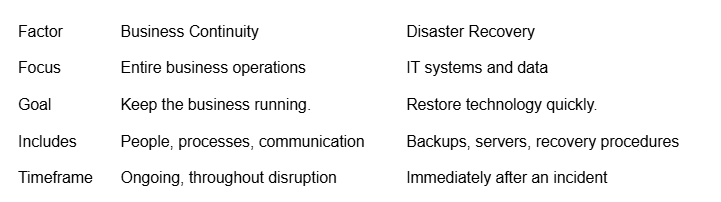
The simplest way to understand business continuity vs disaster recovery is this: business continuity asks “how do we keep operating?” while disaster recovery asks “how do we get our systems back?”

They overlap, but they’re not the same scope:
IT disaster recovery

Neither plan replaces the other. A business continuity plan vs. disaster recovery comparison isn’t really about choosing one — it’s about understanding that they solve different problems, and both are needed for a business to fully recover.

Why Small Businesses Often Get This Wrong

Many small businesses assume data backups are the same as a full recovery strategy. It isn’t. Backups are part of disaster recovery, but without a documented plan for restoring them quickly and in the right order, valuable time is lost when it matters most.


Others build a communication plan for emergencies but never think through the IT side — what happens if the server room floods, or ransomware locks every file on the network? Without a real disaster recovery plan for small businesses, even a strong continuity plan can stall out while waiting on systems never designed to be restored quickly.


The businesses that recover with the least damage are the ones that treat these as two connected pieces of the same puzzle, not one-or-the-other decisions.

Does Your Business Need Both?

The lack of disaster recovery will make any good business continuity plan ineffective. While employees may know where to operate and whom to contact, the lack of recoverable data and systems will mean that a company cannot operate normally.


The lack of business continuity will make any fast technical recovery meaningless. While the technical side of things may be restored, people still need to know what to do and how to do it.


Both options give total insurance coverage. Disaster recovery ensures that the technology is back in place, whereas business continuity ensures the running of the business during that period.

 

IT disaster recovery

Building a Disaster Recovery Plan for Small Businesses

An adequate disaster recovery plan should not be difficult but should definitely be detailed.

Key elements include:

  • Regular and automated backups are taken both on-site and off-site.
  • Defined recovery priorities — which systems come back online first?
  • Clear recovery time and recovery point objectives so expectations are realistic.
  • Tested restoration procedures, reviewed at least annually.
  • Assigned responsibilities, so everyone knows their role during recovery, not just IT.

A plan that’s never been tested is really just a document, not a working strategy. Regular testing is what turns a disaster recovery plan into something you can actually count on.

How ZIA Networks Helps Businesses Prepare for Both

ZIA Networks works with small and mid-sized businesses to build continuity and recovery strategies that fit how they actually operate — not generic templates pulled off a shelf. That means looking at both sides of the equation together, since one without the other leaves real gaps.

Here’s how that is done in practice:

  • Custom disaster recovery planning, from backup planning through recovery goals to proven restore procedures.
  • Business continuity planning assistance, from communications plans through role identification to process mapping.
  • Proven plan testing, to ensure you don’t learn your plan won’t work until there’s really an incident.
  • Constant monitoring and technical assistance to head off problems before they become incidents.
  • Responsive local service, just in case there is an incident.

For businesses trying to weigh business continuity vs disaster recovery and figure out where to start, ZIA Networks helps map out a plan that covers both, built around the size and needs of the business rather than a one-size-fits-all package.


FAQs

Q1. What is the main difference between business continuity and disaster recovery?

Ans: At its core, continuity is about an organisation’s ability to keep functioning even while things around it are falling apart. Disaster recovery is more specific — it’s the process of getting your IT systems and data back online once the dust settles.

Q2. Can a small business have disaster recovery without business continuity? 

Ans: In terms of technical feasibility, yes. Although systems can be easily restored, the absence of a continuity plan could cause employees to struggle with maintaining business operations during restoration.

Q3. How often should a disaster recovery plan for small businesses be tested? 

Ans: At a minimum, once per year, although if systems change often or there is sensitive information, testing the plan should happen more frequently, because a plan that has never been tested will probably fail when it actually needs to be used.

Q4. Is business continuity planning important only for large firms?

Ans: Small firms usually have less margin to compensate for any loss of time in the first place. It is precisely this reason that makes business continuity planning all the more important, maybe even more important than in a big firm.


Final Thoughts

The debate over business continuity vs disaster recovery isn’t really a debate at all — both plans serve different, essential purposes, and most businesses need them working side by side. Disaster recovery gets your systems back; business continuity keeps your business moving while that happens.


ZIA Networks helps businesses build both pieces of that puzzle, so when disruption hits, it’s a bump in the road rather than a full stop. If your business only has one of these plans in place, now is the time to close that gap before an emergency forces the issue.

Share this post
IT disaster recovery

Business Continuity vs. Disaster Recovery: What’s the Difference and Does Your Business Need Both?

When something goes wrong — a server crash, a flood, a ransomware attack — it’s rarely the businesses scrambling in the moment that bounce back fastest. More often than not, it’s the ones who had a plan already written down, tested, and just waiting to be used. That’s usually the point where the business continuity vs. disaster recovery conversation kicks off — and, more often than not, where the confusion starts too.


At ZIA Networks, we talk to plenty of small business owners who use these two terms interchangeably, like they’re just different names for the same thing. They’re not. Getting clear on the difference between BCP and DR isn’t just splitting hairs — it shapes how fast your business is back on its feet after something knocks you off course and how much that downtime ends up costing you in the meantime.


So that’s what this post is really about: what each plan actually covers, how they work together rather than against each other, and why most small businesses need both — not one or the other.

What Is Business Continuity Planning?

Business continuity planning is the broader of the two. It covers how your entire business keeps functioning during and immediately after a disruption — not just your IT systems, but your people, your processes, and your ability to serve customers.


A solid business continuity plan typically answers questions like:

  1. An effective business continuity plan often addresses issues such as
  2. What is the responsibility of whom during emergencies?
  3. How will staff members communicate in case of a breakdown in communication channels?
  4. What are the important business functions and what are not?
  5. Where will staff work if the office is inaccessible?

Think of business continuity as the big-picture playbook for keeping the business alive — payroll still runs, customers still get served, and leadership still knows who’s making decisions — even when something has gone seriously wrong.

What Is Disaster Recovery?

IT disaster recovery is more narrowly focused. This refers to recovering technology systems, data, and infrastructure in the event of an incident such as a cyberattack, system malfunction, or natural disaster.

A typical disaster recovery plan involves:

  • Backup facilities and the frequency of data backups.
  • Recovery Time Objectives (RTO) – how fast restoration should occur.
  • Recovery Point Objectives (RPO) – how much data loss can be tolerated, measured in time.
  • Procedure to restore servers, applications, and access to the network.

In summary, disaster recovery refers to the technical mechanism involved in restoring your systems, while business continuity refers to the processes required in keeping the rest of the business working while this takes place.

Business Continuity vs Disaster Recovery: The Core Difference

The simplest way to understand business continuity vs disaster recovery is this: business continuity asks “how do we keep operating?” while disaster recovery asks “how do we get our systems back?”

They overlap, but they’re not the same scope:

IT disaster recovery

Neither plan replaces the other. A business continuity plan vs. disaster recovery comparison isn’t really about choosing one — it’s about understanding that they solve different problems, and both are needed for a business to fully recover.

Why Small Businesses Often Get This Wrong

Many small businesses assume data backups are the same as a full recovery strategy. It isn’t. Backups are part of disaster recovery, but without a documented plan for restoring them quickly and in the right order, valuable time is lost when it matters most.


Others build a communication plan for emergencies but never think through the IT side — what happens if the server room floods, or ransomware locks every file on the network? Without a real disaster recovery plan for small businesses, even a strong continuity plan can stall out while waiting on systems never designed to be restored quickly.


The businesses that recover with the least damage are the ones that treat these as two connected pieces of the same puzzle, not one-or-the-other decisions.

Does Your Business Need Both?

The lack of disaster recovery will make any good business continuity plan ineffective. While employees may know where to operate and whom to contact, the lack of recoverable data and systems will mean that a company cannot operate normally.


The lack of business continuity will make any fast technical recovery meaningless. While the technical side of things may be restored, people still need to know what to do and how to do it.


Both options give total insurance coverage. Disaster recovery ensures that the technology is back in place, whereas business continuity ensures the running of the business during that period.


IT disaster recovery

Building a Disaster Recovery Plan for Small Businesses

An adequate disaster recovery plan should not be difficult but should definitely be detailed.

Key elements include:

  • Regular and automated backups are taken both on-site and off-site.
  • Defined recovery priorities — which systems come back online first?
  • Clear recovery time and recovery point objectives so expectations are realistic.
  • Tested restoration procedures, reviewed at least annually.
  • Assigned responsibilities, so everyone knows their role during recovery, not just IT.

A plan that’s never been tested is really just a document, not a working strategy. Regular testing is what turns a disaster recovery plan into something you can actually count on.

How ZIA Networks Helps Businesses Prepare for Both

ZIA Networks works with small and mid-sized businesses to build continuity and recovery strategies that fit how they actually operate — not generic templates pulled off a shelf. That means looking at both sides of the equation together, since one without the other leaves real gaps.

Here’s how that is done in practice:

  • Custom disaster recovery planning, from backup planning through recovery goals to proven restore procedures.
  • Business continuity planning assistance, from communications plans through role identification to process mapping.
  • Proven plan testing, to ensure you don’t learn your plan won’t work until there’s really an incident.
  • Constant monitoring and technical assistance to head off problems before they become incidents.
  • Responsive local service, just in case there is an incident.

For businesses trying to weigh business continuity vs disaster recovery and figure out where to start, ZIA Networks helps map out a plan that covers both, built around the size and needs of the business rather than a one-size-fits-all package.


FAQs

Q1. What is the main difference between business continuity and disaster recovery?

Ans: At its core, continuity is about an organisation’s ability to keep functioning even while things around it are falling apart. Disaster recovery is more specific — it’s the process of getting your IT systems and data back online once the dust settles.

Q2. Can a small business have disaster recovery without business continuity? 

Ans: In terms of technical feasibility, yes. Although systems can be easily restored, the absence of a continuity plan could cause employees to struggle with maintaining business operations during restoration.

Q3. How often should a disaster recovery plan for small businesses be tested? 

Ans: At a minimum, once per year, although if systems change often or there is sensitive information, testing the plan should happen more frequently, because a plan that has never been tested will probably fail when it actually needs to be used.

Q4. Is business continuity planning important only for large firms?

Ans: Small firms usually have less margin to compensate for any loss of time in the first place. It is precisely this reason that makes business continuity planning all the more important, maybe even more important than in a big firm.


Final Thoughts

The debate over business continuity vs disaster recovery isn’t really a debate at all — both plans serve different, essential purposes, and most businesses need them working side by side. Disaster recovery gets your systems back; business continuity keeps your business moving while that happens.


ZIA Networks helps businesses build both pieces of that puzzle, so when disruption hits, it’s a bump in the road rather than a full stop. If your business only has one of these plans in place, now is the time to close that gap before an emergency forces the issue.

Share this post

This Is Paul Quintana - he's here to help with your infrastructure.

This Is Paul Quintana – he’s here to help with your infrastructure.
Why not book a convenient 30 minutes with our managing director? He regularly offers these huge value sessions, without charge, to companies who feel overwhelmed with their infrastructure issues and need guidance and the right expertise.

This Is Paul Quintana – he’s here to help with your infrastructure.
It’s a free, no-obligation chat and it could start you on the path to removing the pains of IT.